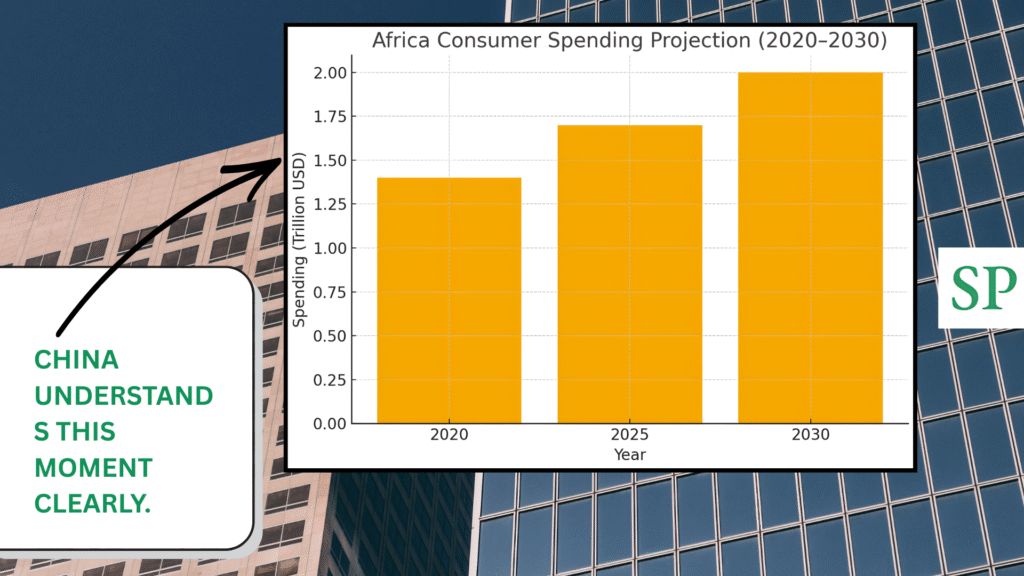
Something big is moving across Africa — quietly, steadily, and much faster than most people realize. China’s old playbook of ports, rails, and megaprojects is fading. In its place? A far more intentional strategy aimed at Africa’s young consumers, rising cities, and a $2 trillion spending wave expected by 2030.
IMF numbers show African economies expanding even as the rest of the world slows. And Beijing sees the timing: the West is tightening restrictions just as Africa opens the door. But here’s the part that really changes the story: Africa isn’t entering this phase with naïveté. Leaders across the continent understand how dependency is created — and how it can quietly hollow out local industries.
This time, policy is deliberate. Guardrails are visible. The real question is no longer why China is accelerating in Africa. It’s whether Africa can convert that urgency into long-term advantage. Let’s unpack it — coffee in hand. ☕️
Africa’s Rise and China’s Urgency Africa’s Consumer Power
First things first — Africa is turning into a major consumer powerhouse. A $2 trillion market taking shape. For China, that’s a rare opportunity. Entering early usually sets the stage for long-term dominance. And with the US and Europe restricting Chinese tech, talent, and trade, Beijing is actively looking for fast-growing new buyers.
Africa consumer spending projection chart showing China’s awareness of Africa’s rising market.
Africa fits perfectly.
Yet, the figures themselves don’t explain everything.
The true allure lies in the characteristics of these consumers.
Africa’s Youth: The Power No One Can Ignore
Image used with courtesy of Nairaland Africa Community, representing everyday market activity across African cities.
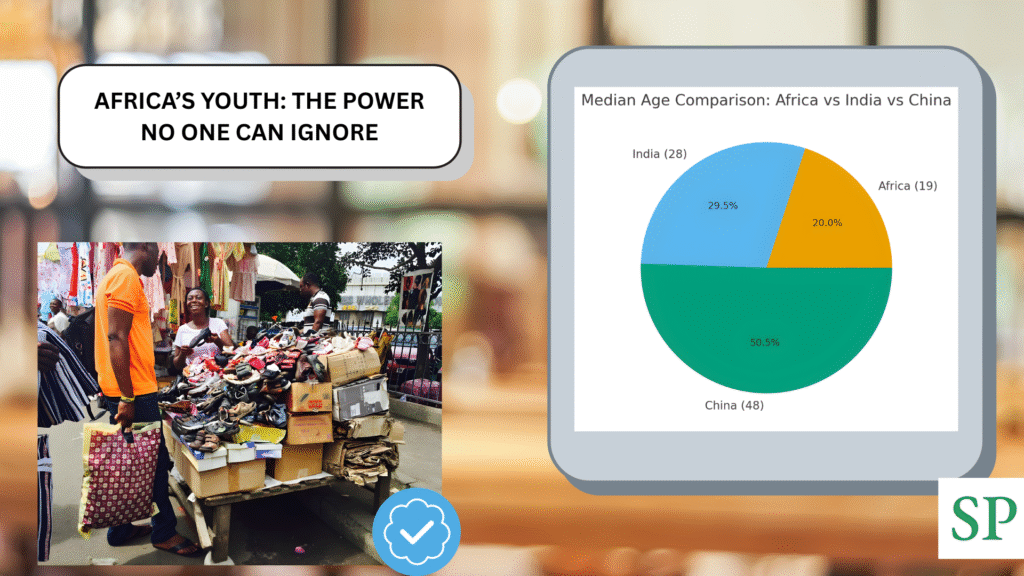
Look at the demographic split:
Africa’s median age: 19
India’s median age: 28
China’s median age: 48
Think about that. China is aging fast. Africa is the youngest major population on Earth.
That means:
more workers
more buyers
more entrepreneurs
more stability
China can’t manufacture youth — it has to partner with it. And Africa has youth in abundance.
China’s Overcapacity Problem — And Africa’s Role
Let me explain something most people don’t talk about: China is making more products than its own people can buy. Factories are overflowing. Domestic demand is slowing.
Beijing urgently needs:
new consumers
new factory locations
new supply chains
Africa ticks all three boxes. That’s why Chinese companies are now setting up factories in Ethiopia, Kenya, Egypt, Rwanda, Zambia, and Ghana. And honestly, that’s not the only thing drawing China in.
Africa Has What the Future Runs On
Copper. Cobalt. Lithium. Manganese.
These minerals power:
electric cars
batteries
smartphones
renewable energy systems
China wants a secure, long-term supply. Africa is the source.
And when opportunity and timing meet, geopolitics follows.
China needs places where politics doesn’t block business. Africa gives China breathing space.
Africa Is Finding Its Economic Voice
The IMF points out that governance is getting better and infrastructure is steadily expanding. And you can see it on the ground — cities like Nairobi, Kigali, Accra, and Lagos are quickly becoming major business hubs in their regions.
China sees something rising — not something falling.
But with China’s rapid expansion comes a critical question…
Will Africa Repeat India’s Mistake? My Friends, Probably Not.
From 1990 to 2020 ,India allowed an influx of Chinese goods:
phones
electronics
toys
machinery
hardware
Local industries weakened. Dependency skyrocketed.
African policymakers have studied this story carefully.
A West African economist summed it up perfectly:
“Foreign investment is welcome, but Africa cannot allow imports to weaken local manufacturing.”
This awareness is Africa’s biggest strength
Will Africa Repeat India’s Mistake?
1. Why Africa Is Better Positioned
Africa Wants Manufacturing — Not Just Import
The African Union’s stance is crystal clear: “Made in Africa for Africa.”
2. Africa wants:
factories
jobs
skills
technology transfer
Not container loads of imports.
3. Jobs Come First
Chinese factories on African soil mean:
real employment
skill-building
local value creation
This is something imports can never provide.
Africa Has Negotiating Power
Earlier, China sent giant state-owned companies.
Now, many entering Africa are smaller, which gives African governments more leverage.
Nigeria, for example, banned certain electronics imports. Transsion — Africa’s biggest phone brand — had no choice but to manufacture locally.
This is policy power in action.
Africa’s Factory Future Is Already Taking Shape
This isn’t theory — it’s happening.
Rwanda is assembling smartphones.
Ethiopia has strong leather and textile factories.
Kenya is assembling solar technology.
Egypt produces home appliances.
Zambia is manufacturing baby products and mining equipment
China is not just selling to Africa anymore. It is producing in Africa.
And that’s a sign of a continent shaping its own future.
What India Can Learn From Africa?
Africa is doing early what India did too late, by negotiating hard, restricting imports, strengthening supply chains, insisting on value addition, and protecting local jobs.
Conclusion
To sum it up, China’s swift growth, throughout Africa is driven by two factors: Africa’s rise — and China’s need.
Africa is set to become the key global economic hub due, to its youthful population, urban expansion and valuable resources.
For Growth Insights, Business News follow this channel – BIZTREND